The steps a sequence can have: talk, wait, decide, act
A call, a WhatsApp, an email. A wait. A condition. A stage change, a task, a meeting, an owner. In one ordered list, run top to bottom.
A sequence is one ordered list, and every line is one of four kinds. Communication steps talk to the person. Wait steps pause. Decide steps check something before continuing. Act steps change the record or hand work to a human. Knowing the four kinds is most of knowing how to write one.
Before you start
- A sequence with a trigger set.
Reference
Talk: an AI call
On a calling line, answered by a voice agent or a call flow. The agent keeps its own instruction, voice and model; the sequence only says when to call. An answered and handled call connects the person and ends the sequence for them.
Talk: a WhatsApp
An approved template if the person is outside the 24-hour window, which they usually are; free text if they messaged you recently. Sent within the broadcast timings on the WhatsApp channel. A reply lands in the shared inbox and connects them.
Talk: an email
From the shared email channel, so a reply comes back into the queue. Best used after the channels above have been tried — email is the door for people who do not answer unknown numbers.
Wait
Four hours. A day. Until a reply, or until working hours resume. A wait that starts at 5pm can be told to continue at 9am rather than 9pm, which is the difference between considerate and irritating.
Decide
Only if the stage is still open. Only if nobody has replied. Only if the last call was not answered. Only if they are not already in another sequence. The step after a decision runs only when it holds; otherwise the sequence skips to the next line that does.
Act: move the lead stage
Qualified after a good call, Contacted after the sequence gives up. Check whether the stage is terminal before you write it — Won, Lost, Not interested, DND and Wrong number remove the person from calling entirely.

Act: task, meeting, owner, note
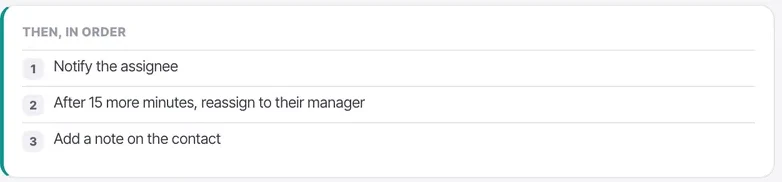
A task for the owner when automation has done what it can. A meeting booked into a real calendar from the AI call. An owner assigned so the person reaches somebody's list. A note saying the sequence ran, so the next human knows.
Stop
Write it. "After that, stop" is not implied. A sequence also stops per person on connection, and when the record moves to a terminal stage.
Put it to use
Read your sequence aloud, naming the kind of each line as you go — talk, wait, decide, act. If two adjacent lines are both "talk" with no wait between them, you are messaging somebody twice in a row.
The parts people get wrong
- Every step lands on the contact's activity feed with a timestamp and the sequence named as the author.
- A meeting booked by a sequence reads the same calendar availability as a booking link, including least notice and the daily cap.
The ones people actually ask
Can a sequence branch?
Through decide steps, one line at a time — "only if nobody has replied, then email". There is no canvas of branches, because a list you can read aloud is the design goal. If you genuinely need two paths, that is usually two sequences with different triggers.
What happens to the sequence if the person replies by email in the middle?
It stops for them. A reply on any channel is a connection, and the conversation is now in the shared inbox for a bot or a person. The sequence does not send its remaining lines to somebody who already answered.