Automation for everything that is not a conversation
Not closed in five days, move it to Lost. Owner deactivated, reassign. Form submitted, create the contact. When this happens · only if · then, in order — for records and state, so campaigns and sequences can handle the talking.
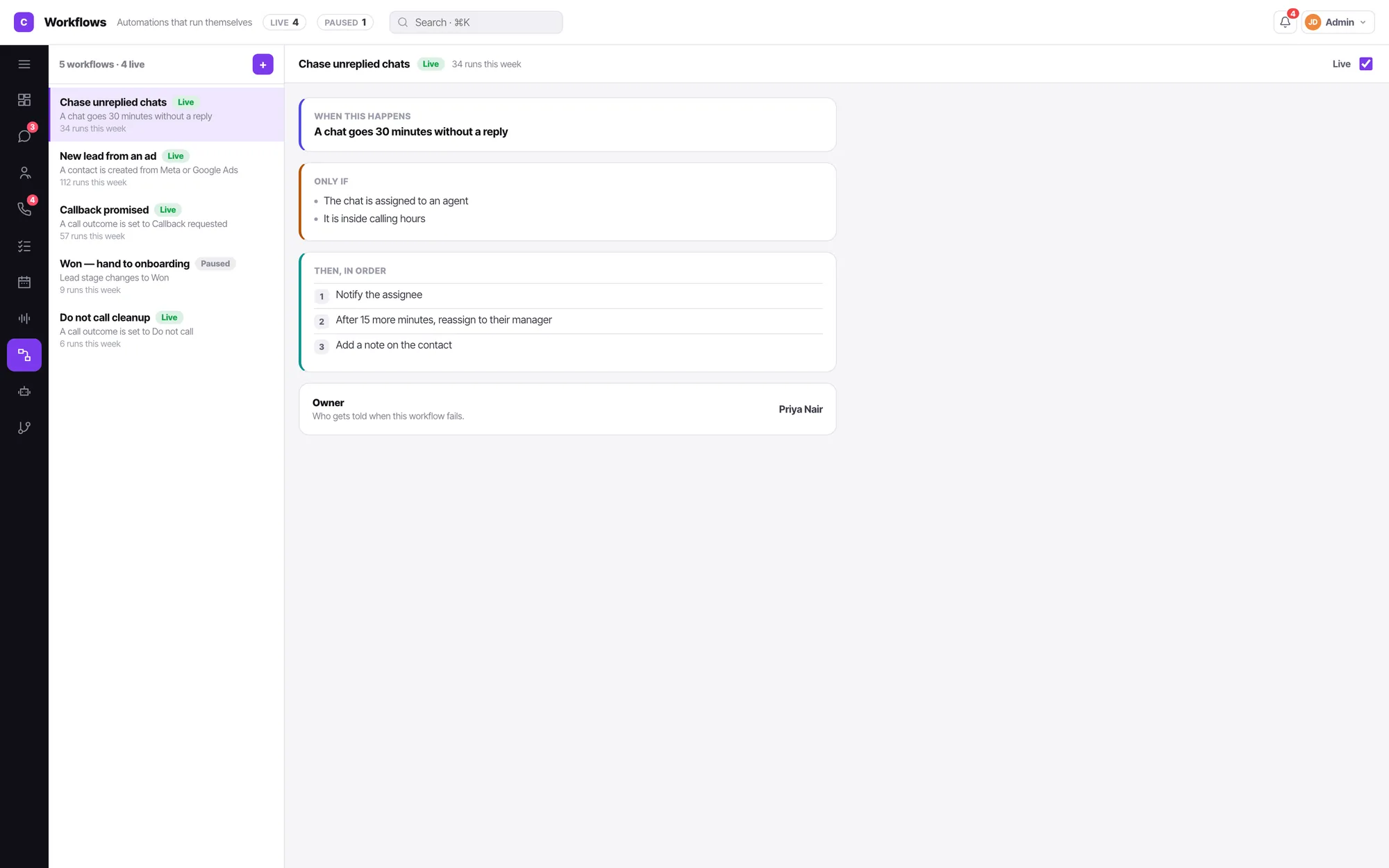
Three blocks, and you are done
When this happens
A contact has sat at a stage for five days. A form is submitted. A user is deactivated. A call outcome is set. A campaign finishes for somebody without connecting.
Only if
The optional narrowing. Only for this channel. Only outside business hours. Only when the lead stage is still open.
Then, in order
Numbered steps that run top to bottom. Move the stage, assign an owner, create a task, add a note, notify somebody on your team, generate a PDF.
The line: a workflow acts on records and your team. It does not run a conversation with the customer. "Not closed in five days, move to Lost" is a workflow. "Call, then WhatsApp, then email until they answer" is a campaign — or, for one person with a stage change and a task along the way, a sequence.
Rules for a pipeline nobody has to remember
- Stale deals close themselves. When a contact has been at Qualified for five days with no activity, move it to Lost and note why.
- New leads are never orphaned. When a contact is created with no owner, assign one — so it reaches somebody's calling list instead of nobody's.
- Leavers hand over cleanly. When a user is deactivated, reassign their open contacts and tasks to their manager.
- The team hears about what matters. When a high-value lead sits unassigned for twenty minutes, notify one named person.
A Live toggle per workflow, an owner who is told when it fails, and managers and admins only — agents never see the item, because automations change everyone's work.
Workflow FAQ
What is a workflow for, and what is it not for?
For everything that is not a conversation. Move a lead to Lost if it has not closed in five days. Reassign a deactivated owner's contacts. Create the contact when a form comes in. Notify a manager when a high-value lead sits unassigned. Workflows keep your records honest while nobody is looking.
Talking to the customer — calls, WhatsApp, email, over time — is what campaigns and sequences are for. A workflow can send a one-off acknowledgement, but if you find yourself writing a second message and a wait, you are building a sequence.
How is a workflow written?
As three plain-English blocks: When this happens, Only if, and Then, in order — with the steps numbered. Anyone on the team can read one and say whether it is right, which is the entire test.
What happens when a workflow fails?
Its owner is told. Every workflow has one, precisely so a broken automation is somebody's problem rather than nobody's.
Can I turn one off without deleting it?
Yes — a Live toggle on each workflow. Turning it off stops it running and keeps the definition.
Who can build workflows?
Managers and admins. Agents do not see the rail item at all, because automations change how everyone's work arrives.
How many automation runs do I get?
5,000 a month on Starter, 15,000 on Growth, 50,000 on Scale and 100,000 on Enterprise. Full comparison.
Written about this
Call outcome and lead stage are different things
One describes an attempt. The other describes a person. Conflating them is why your pipeline reports never reconcile.
ReadChoosing a CRM when your team lives on the phone
Most CRMs are built around a form and treat the call as an attachment. Seven questions that separate the ones that were not.
ReadYour missed calls are a bigger leak than your website
You measure form conversion to two decimal places and have no idea how many people rang and gave up. Here is how to find out, cheaply.
ReadIt is all one product
Everything here reads and writes the same contacts, the same conversations and the same calendar. Nothing needs syncing.
Shared inbox
WhatsApp, Instagram, Facebook, Telegram, Viber, LINE, your web widget, SMS and email land in a single queue your team actually works from.
AI chatbot
One bot answers WhatsApp, Instagram, your web widget, SMS and email — and hands the conversation to a person the moment your condition says it should.
AI voice agents
An AI agent answers your line in natural speech, follows your prompt, calls your functions, and hands to a human the moment it should.
Call flows
Ring agents, hand to an AI agent, branch on a condition, run an IVR menu, check business hours, take voicemail — as one flow you can read.
Campaigns
AI call. No pickup, WhatsApp. Four hours on, call again. Still nothing, email. Written as sentences, running from a day to two months, across every channel your customer actually uses.
Sequences
Someone fills a form, or you enrol them by hand. Then a call, a WhatsApp, a wait, an email — and along the way a stage change, a task, a booked meeting. A campaign and a workflow in one.
WhatsApp marketing
Send an approved template to an audience, hold it to the hours somebody can reply, and let every answer land in the shared inbox — where an AI agent or your team picks it up.
Email marketing
Send to a segment built from the same contacts, stages and call outcomes the rest of the product uses. Replies land in the shared inbox. One record per person, not a separate list.
Contacts & CRM
Lead stages that mean something, a schema you define yourself, and every call, chat and note on one timeline.
Calendar & booking
Connect Google or Microsoft, publish a booking link with your real availability, and let the AI agent book straight into it.