A campaign for one person, that can also change their record
Someone fills a form, or you enrol them by hand. Then a call, a WhatsApp, a wait, an email — and along the way a stage change, a task, a booked meeting. A campaign and a workflow in one.
Campaign, sequence, workflow — which one you want
They share the same plain-English steps. What differs is who they run on and what they are allowed to touch.
Campaign
Runs on an audience you chose. Reaches each person across AI calls, WhatsApp and email until they connect. Communication only.
Sequence
Runs on one person, started by a form fill or by enrolling them. The same communication steps — plus stage changes, tasks, meetings and assignment.
This page.
Workflow
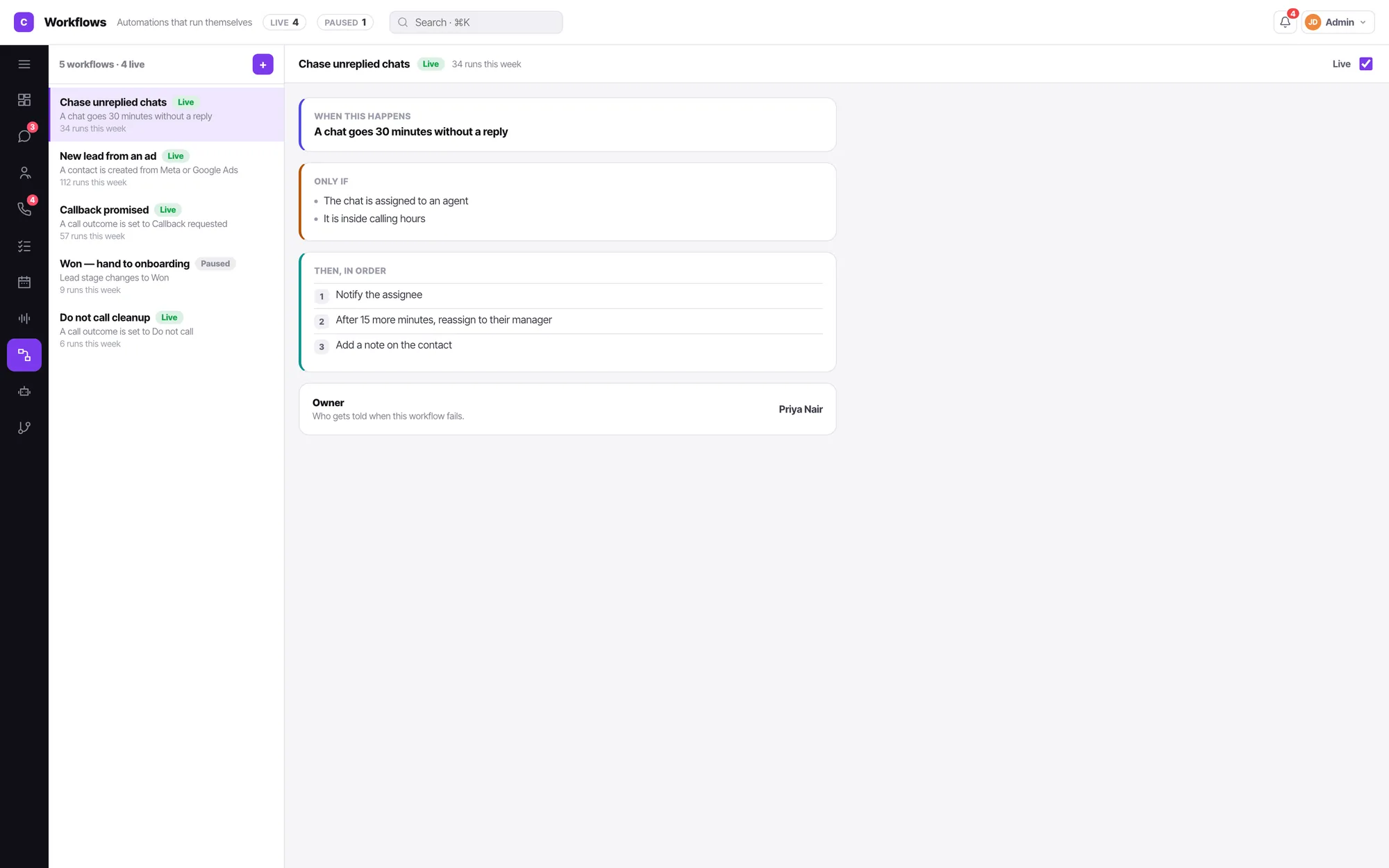
Runs on an event, and never talks to the customer. Records and state: stages, owners, tasks, notifications to your team.
A form fill, followed all the way to a meeting
“When somebody submits the demo form: call them within two minutes. If they pick up and qualify, move them to Qualified and book a slot from Priya's calendar. If nobody answers, WhatsApp them the booking link. Wait a day. Still nothing, email, and create a task for the owner to try once by hand. If there is no reply in a week, move them to Contacted and stop.”
Calls, messages, a wait, a stage change, a booking and a task — in one ordered list, for one person, started by one thing they did. That is the whole idea.
Talk, wait, decide, act
Talk
An AI call on a calling line. A WhatsApp — a template outside the 24-hour window, free text inside it. An email from a connected mailbox.
Wait
Four hours. A day. Until a reply, or until a working hour — a wait that starts at 5pm can be told to resume at 9am.
Decide
Only if the stage is still open. Only if nobody has replied. Only if the call was not answered. The step after a decision runs only when it holds.
Act
Move the lead stage. Create a task for a person. Book a meeting into a real calendar. Assign an owner. Add a note so the next human knows what happened.
Triggered by the customer, or by you
- A form submission. The website form, a landing page, a lead form on an ad. Speed to lead is the metric with the most reliable link to revenue, and this is how you get it without a person watching a queue.
- A booking, a stage change, a catch hook. Anything that means "this person just became worth a conversation".
- By hand. From the contact record or from inside a chat: put this person in the renewal sequence. For the one customer who needs the full treatment.
Every step lands on the contact's activity feed with a timestamp, so whoever picks up the phone next can see the three attempts, the email, and the task that was created — and does not start from zero.
Sequence FAQ
How is a sequence different from a campaign?
A campaign runs on an audience you selected. A sequence runs on one person at a time, started by something they did or by you enrolling them, and it can do things a campaign cannot: change their lead stage, create a task for a colleague, book a meeting into a calendar, assign the contact. Same channels, same plain-English steps — a sequence just knows one person and can act on their record.
How is a sequence different from a workflow?
A workflow is automation for records and state — "not closed in five days, move to Lost" — and it does not talk to the customer. A sequence is built around talking to the customer, and borrows a workflow's actions for the moments in between. If the thing you are building has a call or a message in it, it is a sequence. If it never contacts the customer, it is a workflow.
What starts a sequence?
A form submission is the common one — somebody fills in your website form and the sequence starts calling within the minute. A booking, a stage change and a catch hook from an outside system work too. And you can enrol somebody by hand from their record or from a conversation, for the one person who needs the full treatment.
What can a step do?
Communicate: an AI call, a WhatsApp, an email. Wait: an hour, a day, until a reply. Decide: only if the stage is still open, only if nobody has replied. Act: move the lead stage, create a task, book a meeting, assign an owner, add a note. Steps run in the order you wrote them.
When does it stop?
When the person connects — a call answered and handled, a reply on any channel — or when your sequence reaches the line where you said stop, or when the record moves to a terminal stage. A sequence will not keep messaging somebody who booked a meeting from step three.
Can somebody be in two sequences at once?
Design them so they are not. A person who filled in two forms does not want two sets of calls. Use an "only if not already in a sequence" condition at the start, and let the first one own them.
Written about this
Five minutes: the number that decides who gets the customer
Buyers overwhelmingly go with whoever answers first, not whoever is best. Most companies answer in hours. Here is how to close that gap without hiring.
ReadWrite your follow-up sequence the way you would brief a new agent
Retry-after and max-attempts fields describe a machine. Sentences describe the job. Convarza takes the sentences.
ReadThe enquiry that went quiet is not lost yet
Someone asked a question, you answered, and nothing. What to send, when, and how many times before it becomes harassment.
ReadIt is all one product
Everything here reads and writes the same contacts, the same conversations and the same calendar. Nothing needs syncing.
Shared inbox
WhatsApp, Instagram, Facebook, Telegram, Viber, LINE, your web widget, SMS and email land in a single queue your team actually works from.
AI chatbot
One bot answers WhatsApp, Instagram, your web widget, SMS and email — and hands the conversation to a person the moment your condition says it should.
AI voice agents
An AI agent answers your line in natural speech, follows your prompt, calls your functions, and hands to a human the moment it should.
Call flows
Ring agents, hand to an AI agent, branch on a condition, run an IVR menu, check business hours, take voicemail — as one flow you can read.
Campaigns
AI call. No pickup, WhatsApp. Four hours on, call again. Still nothing, email. Written as sentences, running from a day to two months, across every channel your customer actually uses.
WhatsApp marketing
Send an approved template to an audience, hold it to the hours somebody can reply, and let every answer land in the shared inbox — where an AI agent or your team picks it up.
Email marketing
Send to a segment built from the same contacts, stages and call outcomes the rest of the product uses. Replies land in the shared inbox. One record per person, not a separate list.
Workflows
Not closed in five days, move it to Lost. Owner deactivated, reassign. Form submitted, create the contact. When this happens · only if · then, in order — for records and state, so campaigns and sequences can handle the talking.
Contacts & CRM
Lead stages that mean something, a schema you define yourself, and every call, chat and note on one timeline.
Calendar & booking
Connect Google or Microsoft, publish a booking link with your real availability, and let the AI agent book straight into it.