WhatsApp broadcasts that a bot or a person can answer
Send an approved template to an audience, hold it to the hours somebody can reply, and let every answer land in the shared inbox — where an AI agent or your team picks it up.
A broadcast tool sends. This one also answers.
Most WhatsApp marketing tools end at delivery. Here the reply is a conversation on a channel that already has a bot or a team on it — the same inbox, the same contact record, the same person who rang you last week.
An audience from your CRM
Segment by stage, source, attribute or last activity with the same filter builder the rest of the product uses. Not a separate list you upload and forget.
An approved template
Managed on the WhatsApp channel, with variables, samples and buttons. Approvals and rejections arrive in your notification feed.
Replies that get handled
Every answer lands in the shared inbox on the WhatsApp channel — answered by an AI agent at once, or by your team, with the full history beside it.
Sends wait for the hours somebody can reply
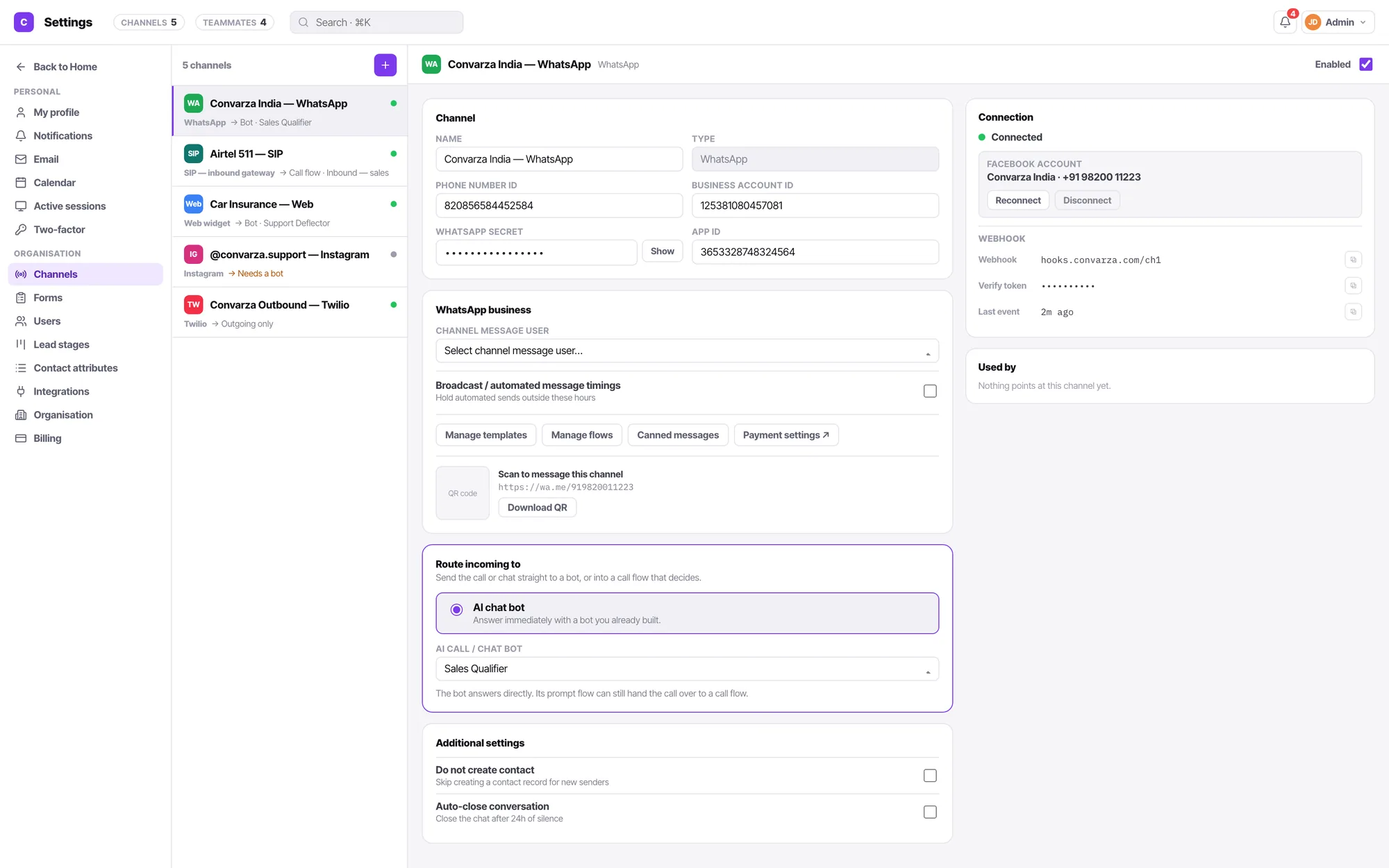
Broadcast timings live on the WhatsApp channel. A send scheduled outside them waits. That is the difference between a campaign at 9am and a queue of irritated people at 9pm — and it is about the customer's timezone, not your office's.
- Template, audience, timing. Three decisions, and the third is usually the one people skip.
- Every send is a line on the contact's activity feed.
- A reply ends the broadcast for that person and starts a conversation.
Broadcast, campaign or sequence
WhatsApp broadcast
One message, many people, now. An offer, an announcement, a reminder. Replies handled in the inbox.
Campaign
Reach each person in an audience over time, across calls, WhatsApp and email, until they connect.
Sequence
One person, triggered by what they did — and able to move their stage, create a task or book a meeting along the way.
WhatsApp marketing FAQ
Do I need an approved template to send a broadcast?
Yes, for anyone outside the 24-hour window — which is everybody a broadcast reaches. Meta reviews templates for category, variable placement and sample values, and rejections are almost always one of those three. Approval and rejection both appear in your Convarza notification feed.
What happens when somebody replies?
The reply lands in the shared inbox as a conversation on the WhatsApp channel, answered by whatever that channel is pointed at — an AI agent immediately, or your team. That is the difference from a broadcast tool: the reply is not an email notification, it is a conversation somebody is already handling.
Can I send at 9pm?
You can, and the replies will arrive at 9pm too. Broadcast timings on the WhatsApp channel hold automated sends to the hours somebody can answer, which is not the same as your opening hours. Set them to when a reply will actually be read.
Who is the audience?
A segment from Contacts, built with the same filter builder as everything else: stage, source, last activity, any attribute you defined, a saved view. Because it is the same record, "everyone at Qualified who has not been contacted in 30 days" is a real, current list rather than an export from last month.
How is this different from a campaign?
A broadcast is one message to many people, now. A campaign is a sequence over time across channels — call, then WhatsApp, then email — that stops per person when they connect. Use a broadcast for an announcement or an offer; use a campaign when the point is to reach each individual.
Are there limits on how many I can send?
Meta sets messaging limits per number that grow with quality rating and volume, and a rejected or reported broadcast lowers them. Convarza shows the WhatsApp channel's state and holds sends to your timings; Meta decides the ceiling. Warm a new number up rather than sending to ten thousand people on day one.
Written about this
Message templates that get approved, with examples
Six templates you can adapt today — order updates, reminders, callbacks, re-engagement — with the category each should be filed under and why.
ReadWhatsApp messaging limits and quality rating, explained
Your number has a tier and a quality score. Both move on their own, and the way most businesses discover them is by hitting one.
ReadWhatsApp Business API in India: what you are actually buying
Everyone resells the same API. What differs is the inbox on top, who owns the number, and what happens when a template gets rejected at 9pm.
ReadIt is all one product
Everything here reads and writes the same contacts, the same conversations and the same calendar. Nothing needs syncing.
Shared inbox
WhatsApp, Instagram, Facebook, Telegram, Viber, LINE, your web widget, SMS and email land in a single queue your team actually works from.
AI chatbot
One bot answers WhatsApp, Instagram, your web widget, SMS and email — and hands the conversation to a person the moment your condition says it should.
AI voice agents
An AI agent answers your line in natural speech, follows your prompt, calls your functions, and hands to a human the moment it should.
Call flows
Ring agents, hand to an AI agent, branch on a condition, run an IVR menu, check business hours, take voicemail — as one flow you can read.
Campaigns
AI call. No pickup, WhatsApp. Four hours on, call again. Still nothing, email. Written as sentences, running from a day to two months, across every channel your customer actually uses.
Sequences
Someone fills a form, or you enrol them by hand. Then a call, a WhatsApp, a wait, an email — and along the way a stage change, a task, a booked meeting. A campaign and a workflow in one.
Email marketing
Send to a segment built from the same contacts, stages and call outcomes the rest of the product uses. Replies land in the shared inbox. One record per person, not a separate list.
Workflows
Not closed in five days, move it to Lost. Owner deactivated, reassign. Form submitted, create the contact. When this happens · only if · then, in order — for records and state, so campaigns and sequences can handle the talking.
Contacts & CRM
Lead stages that mean something, a schema you define yourself, and every call, chat and note on one timeline.
Calendar & booking
Connect Google or Microsoft, publish a booking link with your real availability, and let the AI agent book straight into it.