AI voice agents that pick up, qualify and book
An AI agent answers your line in natural speech, follows your prompt, calls your functions, and hands to a human the moment it should.
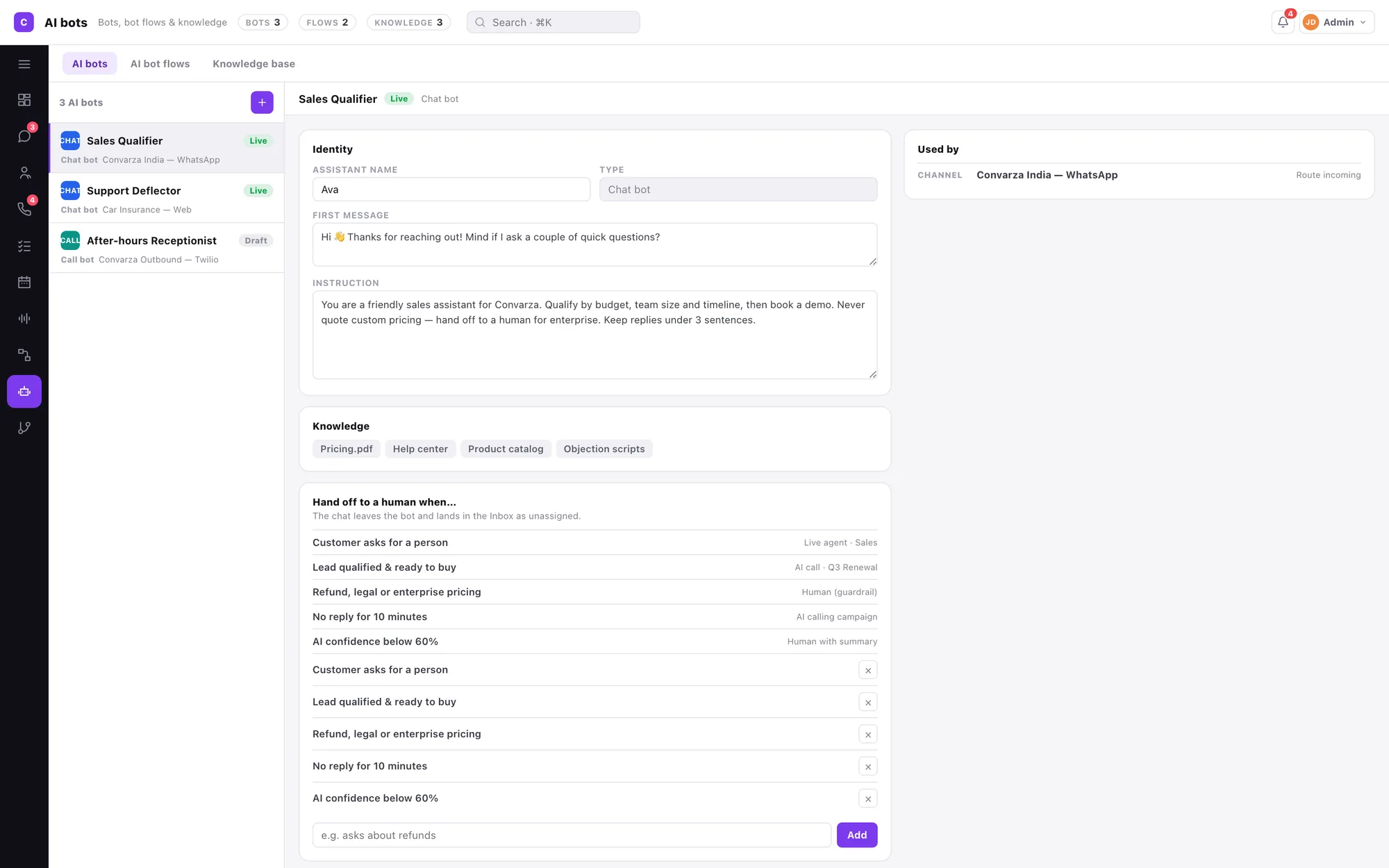
A bot owns itself, and nothing else
The most useful decision in Convarza AI is a boundary: an AI bot knows its prompt, its voice and its functions — and knows nothing about where it is used. You point a channel, a call flow or a campaign at it. One bot, many places, one place to change it.
Prompt & first message
What it is for, how it should behave, and the exact line it opens with.
Voice per language
One agent, right accent. Set the voice for each language it is allowed to speak.
Functions
The things it may do mid-call — look something up, create a record, offer a slot.
Knowledge base
PDFs, documents and crawled pages, indexed. One KB can serve many bots.
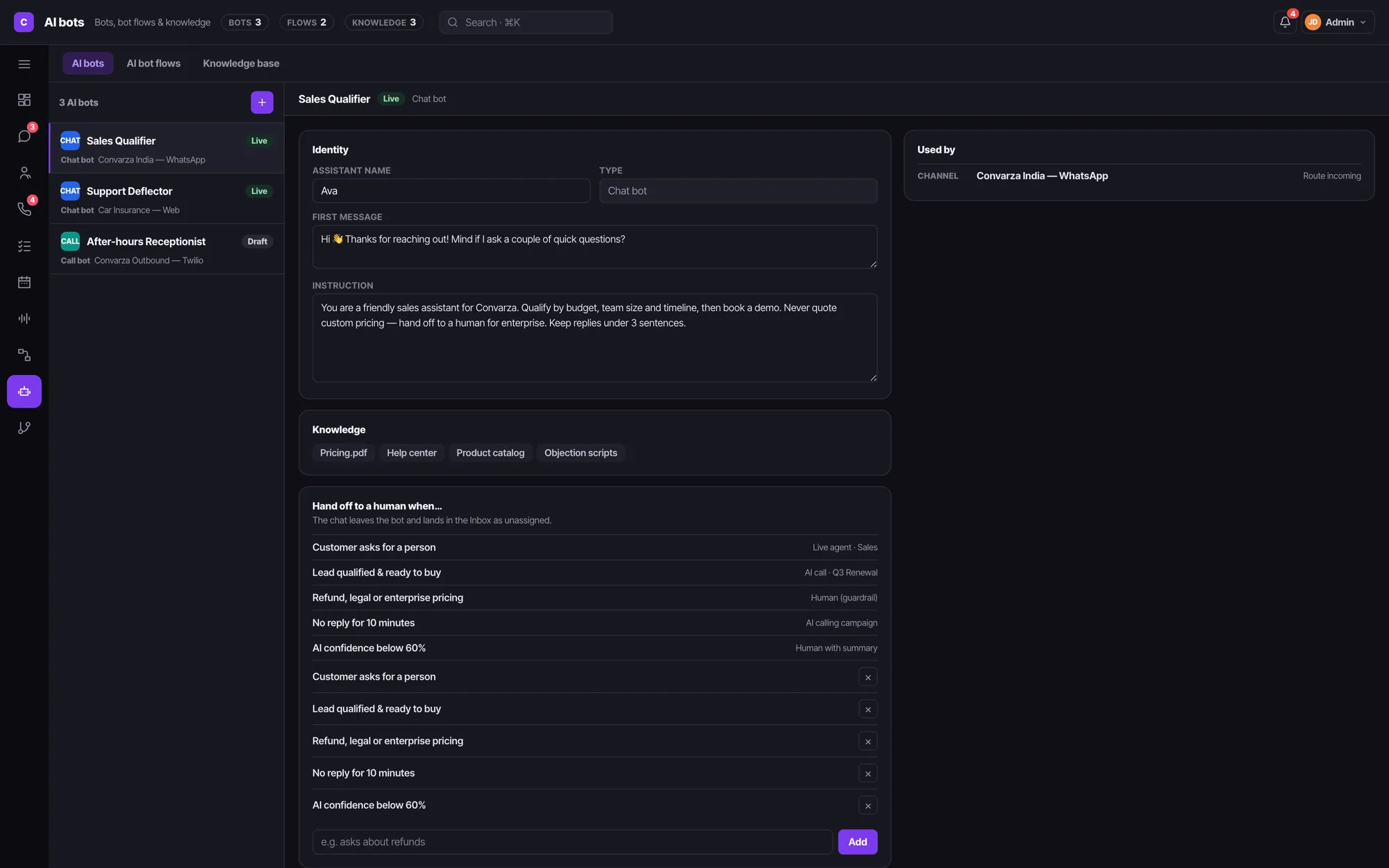
Bots, bot flows, knowledge bases
Under one "AI bots" heading there are three things, because they have three different lifetimes.
- AI bots — the agent itself: prompt, opening line, voice, functions, model.
- AI bot flows — bots chained in order, each step carrying the handover condition that moves the conversation to the next one.
- Knowledge base — documents and crawled pages, indexed once, used by many bots.
Agents never see any of it. Managers and admins do — it is daily building work, not configuration, which is why it sits in the rail and not buried in settings.
One line answers with one thing
A channel points at an AI bot, or at a call flow. Never both, never neither — which is the only reason you can ever say for certain what picked up the phone.
Straight to the agent
The AI bot answers immediately. Good for an after-hours line, an overflow number, or a campaign that only needs to qualify.
Through a call flow
Steps decide: ring agents first, check business hours, run an IVR menu, then hand to the AI agent — or take voicemail. See call flows.
The graph is deliberately cyclic. A call flow can contain an AI call bot as a step; an AI call bot can hand back to a call flow; a flow can nest another flow. That is why every flow carries a Used-by list.
Bring your own carrier
Twilio
Point a Twilio number at Convarza and choose what answers it: your agents, an AI voice agent, or a call flow.
Maqsam
Connect your Maqsam account, set the region and direction, and route the line like any other.
SIP — outbound
Username, password, port, server, protocol and media encryption — with registration if your carrier wants it.
SIP — inbound gateway
Give the IP or domain of your gateway and the protocol. Incoming calls hit your flow or your AI agent.
Every calling channel gets Resource, Region, Direction and Additional settings — forwarded-from numbers, forward-to number, IP/domain match list, ping timeout and allowed concurrent calls.
How automated AI phone calls actually work
Most "automated calls" still play a recorded message and wait for a keypress. Convarza AI voice agents are different: they listen in real time, understand intent through large-language-model reasoning, and respond in natural speech — all within a single phone call, with no human in the loop unless your rules say otherwise.
Inbound call received
The moment a call arrives on your Twilio, Maqsam or SIP number, Convarza routes it to the assigned AI voice agent within milliseconds — no on-hold music, no IVR tree to navigate.
Real-time speech understanding
The caller speaks naturally. The agent transcribes audio, parses intent using your chosen LLM (GPT-4o, Claude 3.5 Sonnet, Gemini 1.5 Pro) and matches the request against your prompt and attached knowledge base in under a second.
Live function execution
Need an order status? The agent calls your API mid-sentence, reads back the result and continues the conversation — no hold time, no "let me check that for you" dead air. Functions run inside the call, not before or after it.
Intelligent handoff or wrap-up
Your prompt defines the guardrail. When the agent detects a complaint, a billing dispute or any trigger you name, it announces the transfer and hands the live call to a human agent — carrying the full conversation summary with it. Human agents receive the call in the shared inbox with full context already loaded.
Your CRM, updated on every call — automatically
A voice AI agent is only as useful as the data it surfaces and the records it creates. Convarza connects to your CRM through standard function calls, so every conversation becomes a structured data event rather than a lost interaction.
- Read before answering. The agent looks up the caller by phone number before responding, so it can greet a returning customer by name and skip questions they already answered last time.
- Write while talking. Booking confirmed? A new record lands in your CRM while the call is still live — no post-call data entry, no delay, no missed follow-up.
- Structured call summaries. Each call ends with a JSON-formatted disposition, intent classification and transcript excerpt pushed directly to the contact timeline in Salesforce, HubSpot, Zoho or any REST-accessible system.
- No-code function builder. Map your CRM API endpoints in the Convarza function editor — no middleware, no ETL pipeline, no engineering sprint required.
What your CRM receives after every AI call
- 📞 Call date, duration and outcome (booked / not interested / escalated)
- 📝 Full transcript or key-turn summary
- 🏷️ Intent tag and sentiment score
- 📅 Next-action date if a meeting was booked
- 🔗 Call recording for compliance review
Data structure is configurable per function. Push different fields to different CRM objects depending on call outcome.
Multi-step call workflows that run themselves
A single AI voice agent handles one job well. A call workflow chains multiple specialised agents together so that a single inbound call can qualify, route, inform, book and close — each step handed off with full context from the step before.
Sequential agent chaining
Build a flow where Agent A qualifies intent, then hands the call to Agent B for product detail, then to a human queue if a demo is requested. Each handover carries the conversation history so nothing is repeated.
Conditional branching logic
Define conditions in plain language on each bot step: "if the caller mentions a refund, exit to the billing agent." The flow evaluates the condition live, not via a pre-programmed keypress — the caller never knows there is a diagram behind the conversation.
Scheduling and callback flows
When a call arrives outside business hours, the workflow can offer an AI-handled self-service path, take a voicemail, or schedule an automatic callback at a time the caller chooses — all without touching your human team's queue. Combine with call flows to build sophisticated after-hours routing with business-hours awareness.
Cyclic flows are supported. An AI call flow step can hand off to another call flow, which can hand back — for escalation loops, retry logic or multi-department routing. Every flow shows its Used-by dependents, so you always know what changes before you make them.
Where AI voice agents deliver the most value
The highest-ROI deployments share one trait: they replace a repetitive, rule-governed call type that consumes agent hours without requiring human judgement. Below are the most common starting points — and what each one unlocks.
Appointment scheduling and reminders
Healthcare clinics, salons, car dealerships and home-service companies use AI voice agents to confirm, reschedule and cancel bookings 24 hours a day. The agent checks real-time calendar availability, books the slot and sends a confirmation — no receptionist required for routine scheduling calls.
Outbound lead qualification
B2B and B2C sales teams run AI-powered outbound call campaigns that dial a list, open with a personalised first line, ask qualifying questions, score the lead and route hot prospects directly to a live sales rep — all before a human touches a dialpad.
Customer support first response
Instead of a queue and a menu, callers speak to an AI agent that handles order status, password resets, refund eligibility checks and FAQ resolution on the first call, escalating only when the issue genuinely needs a trained human to resolve it.
Debt collection and payment reminders
Financial services companies deploy compliant AI calling agents that deliver payment reminders, capture partial payment agreements and route disputes to collectors — reducing the cost per collected dollar while maintaining regulatory compliance through full call transcripts.
Multilingual customer engagement
A single Convarza bot can be configured with different voices per language, meaning one agent handles English, Arabic and French callers without routing to separate queues or building separate bots — critical for regional businesses and multinational contact centres.
Post-call surveys and feedback capture
Immediately after a human agent ends a call, an AI voice agent can auto-dial the customer, deliver a short NPS or CSAT survey, record the score and push structured results to your analytics platform — response rates are 3–5× higher than SMS surveys for the same question set.
Measurable results from AI voice automation
AI voice agents are not a cost centre — they are a revenue and efficiency multiplier. Teams that replace rule-based IVR systems and after-hours voicemail with Convarza AI calling agents typically see the following outcomes within the first sixty days of deployment.
Lower cost per resolved call
Routine enquiries — order status, store hours, appointment confirmation — cost a fraction of the price when handled by an AI agent compared to a live agent. Teams redirect human effort to complex, high-value interactions where empathy and creativity matter.
24/7 coverage with zero overtime
AI voice agents do not sleep, take breaks or require shift premiums. Your phone lines answer at 2 am on a public holiday the same way they answer at 10 am on a Tuesday — with the same voice, the same knowledge base and the same first-call resolution rate.
Elastic capacity at call peaks
A marketing campaign, a product launch or a seasonal rush can multiply inbound call volume overnight. AI voice agents scale to handle the spike without emergency hiring, training cycles or service degradation — capacity follows demand, not headcount.
Consistent compliance and quality
Every call follows the same prompt, every time. No agent having a bad day, no off-script promises made under pressure. Full transcripts are stored per call, giving quality assurance, legal and regulatory teams an auditable record of every customer interaction without manual call sampling.
The compounding effect. CRM records filled automatically, leads qualified overnight, appointments booked without staff time, and surveys returned immediately after each call — the data advantage builds month on month, feeding better AI decisions, better segmentation and higher revenue per contact.
Page reviewed and updated: — content verified against current Convarza AI voice agent capabilities, supported carriers and LLM model options.
AI voice agent FAQ
What can an AI voice agent actually do on a call?
It opens with your first message, follows the prompt you wrote, answers from a knowledge base you attached, calls the functions you gave it — look up an order, check availability, create a contact — and books into your calendar. When your guardrail says a human should take it, it hands over.
How good are the voices?
The same ultra-realistic voices are on every plan, Starter included. Voice is set per language on the bot, so an agent can sound right in English and in Hindi without being two bots. Plans differ on volume, not on how the agent sounds.
Which model does it run on?
You choose per bot — Claude, GPT, Gemini, or a low-latency hosted option when response time matters more than reasoning depth. The prompt, first message, functions and call timings all live on the bot alongside it.
Can the same bot answer chat and calls?
A bot is created as a chat bot or a call bot, because the two need different things — a call bot has timings and voices, a chat bot does not. Both are built in the same place and both know nothing about where they are used.
How do I stop a bot being deleted while something depends on it?
Every bot, flow and knowledge base shows a Used by list of the channels, campaigns and flows pointing at it. A referenced object is not silently deletable.
Does it work on my existing phone numbers?
Yes. Point a Twilio number, a Maqsam line, a SIP trunk or a SIP inbound gateway at Convarza and choose what answers it. The line keeps its own credentials, region, direction and calling hours.
What is the difference between an AI voice agent and an IVR?
An IVR plays a recorded menu and waits for a keypress — it cannot understand speech, adapt to unexpected answers or hold a conversation. An AI voice agent listens to natural speech, understands intent, answers from a knowledge base, executes functions mid-call and makes decisions. The practical difference: an IVR abandons a caller who says something unexpected; an AI voice agent handles it the same way a trained human would.
How much does an AI voice agent cost to run per call?
Three meters run simultaneously on every AI call: telephony (per minute on your Twilio, Maqsam or SIP line), speech processing (transcription and text-to-speech), and LLM inference (the model reasoning behind each response). Convarza bundles these into a per-minute AI calling rate on each plan — check the pricing page for the current rate. Short, well-scoped calls cost significantly less than long, reasoning-heavy ones, so a tight prompt reduces cost as well as latency.
Can AI voice agents make outbound sales calls automatically?
Yes. An AI voice agent can be assigned to an outbound calling campaign that works through a contact list, opens each call with your scripted first line, asks qualifying questions, scores the lead and either books a meeting directly or routes a warm transfer to a live sales rep. The campaign stops dialling an individual the moment they connect or express a clear disinterest — no robocalling loops, no repeated calls to the same number.
Written about this
What an AI voice agent actually does on a call
Not a recording, not a menu, not a chatbot reading aloud. Here is what happens between the ring and the hang-up, and which parts you control.
ReadWhat an AI receptionist should answer after hours — and what it should not
The calls you miss between 7pm and 9am have a floor of zero, which makes them the safest place to start. The trick is knowing where to stop.
ReadSIP trunk, cloud telephony or a carrier number — which line should your AI agent answer?
The line you connect decides your per-minute cost, your control over routing, and how bad a bad day gets. A plain comparison of the three.
ReadIt is all one product
Everything here reads and writes the same contacts, the same conversations and the same calendar. Nothing needs syncing.
Shared inbox
WhatsApp, Instagram, Facebook, Telegram, Viber, LINE, your web widget, SMS and email land in a single queue your team actually works from.
AI chatbot
One bot answers WhatsApp, Instagram, your web widget, SMS and email — and hands the conversation to a person the moment your condition says it should.
Call flows
Ring agents, hand to an AI agent, branch on a condition, run an IVR menu, check business hours, take voicemail — as one flow you can read.
Campaigns
AI call. No pickup, WhatsApp. Four hours on, call again. Still nothing, email. Written as sentences, running from a day to two months, across every channel your customer actually uses.
Sequences
Someone fills a form, or you enrol them by hand. Then a call, a WhatsApp, a wait, an email — and along the way a stage change, a task, a booked meeting. A campaign and a workflow in one.
WhatsApp marketing
Send an approved template to an audience, hold it to the hours somebody can reply, and let every answer land in the shared inbox — where an AI agent or your team picks it up.
Email marketing
Send to a segment built from the same contacts, stages and call outcomes the rest of the product uses. Replies land in the shared inbox. One record per person, not a separate list.
Workflows
Not closed in five days, move it to Lost. Owner deactivated, reassign. Form submitted, create the contact. When this happens · only if · then, in order — for records and state, so campaigns and sequences can handle the talking.
Contacts & CRM
Lead stages that mean something, a schema you define yourself, and every call, chat and note on one timeline.
Calendar & booking
Connect Google or Microsoft, publish a booking link with your real availability, and let the AI agent book straight into it.