Task reminders and the 15-minute default
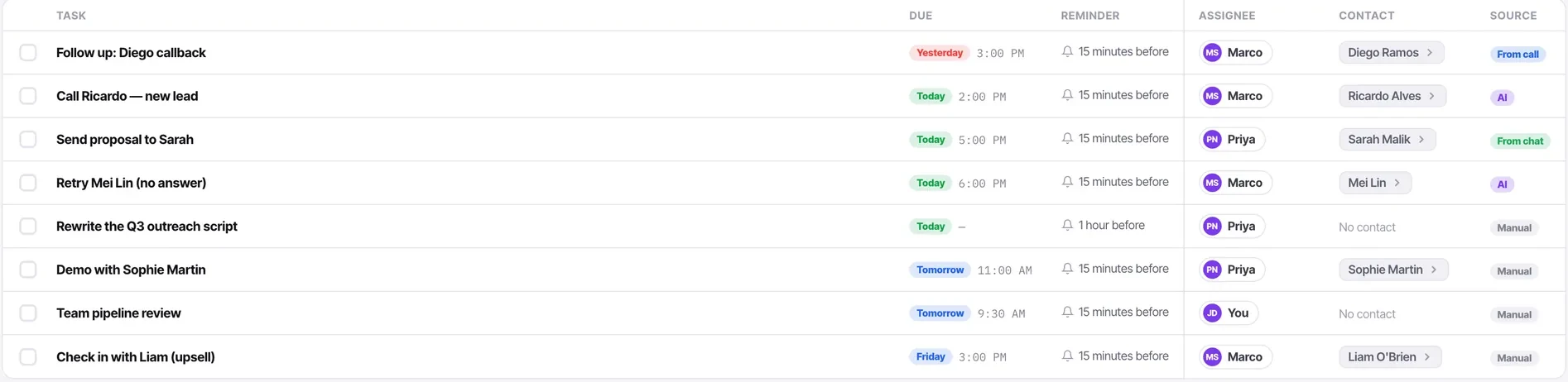
The 15-minute default is right for something you are about to do, and wrong for a real follow-up. Leaving it on a Thursday task teaches you to ignore reminders.
Reminders are set per task and default to 15 minutes before. That default is right for the situation it was designed for — you are on a chat, you need to check something, you will be back in a moment — and wrong for almost everything else.
The failure it causes is subtle and worth naming: a Thursday task with a 15-minute reminder pings you on Thursday, by which point you have learned that reminders arrive when it is already too late to plan. People stop trusting the whole system on the strength of a few of these.
Before you start
- A task to set one on.
- Mobile notifications turned on, or the reminder only exists while you are looking at the product.
Steps
Understand the default
A task created from a chat is auto-assigned to you with a 15-minute reminder and opens expanded.
Keep it for "I am about to do this"
Check something and come back inside the hour. Fifteen minutes is right and you should change nothing.
Change it for a real follow-up
For something due on Thursday, a reminder an hour before gives you time to prepare. For a call, thirty minutes lets you read the record first.
Set the reminder for when you can act
A reminder at 6pm about something requiring a phone call is a reminder to feel guilty. Move it to the morning.
Turn on mobile notifications
Reminders reach you where you are. Without them the reminder is only visible if you happen to be looking at the product, which defeats the purpose.
Watch what automation sets
Tasks created by workflows and by AI carry reminders too. If those are arriving at unhelpful times, the workflow is where to fix it.
Check it worked
Look at your next five reminders and ask, of each, whether it arrives in time to actually do the thing. Any that do not are training you to dismiss the rest.
The parts people get wrong
- A callback requested during a call creates a task at the time you agreed with the customer, not at the 15-minute default.
- Reminders are per task rather than a global preference, so a badly timed one is always fixable on the task itself.
The ones people actually ask
Why is my reminder set to 15 minutes?
That is the default for a task created from a chat, along with being auto-assigned to you. It is right for I am about to do this and wrong for everything else — if it is due Thursday, set Thursday.
Reminders arrive when I cannot act on them.
Set the reminder for when you can act rather than when the task is due. A reminder at 6pm about something needing a phone call is a reminder to feel guilty. For a call, thirty minutes ahead lets you read the record first.
Automated tasks are arriving at unhelpful times.
Fix it in the workflow that creates them, not on each task. Tasks created by workflows and by AI carry reminders too, and the workflow is the single place to change them.