
The calling list: what "to call" means
Every contact assigned to you, whose lead stage is still open, that you have not called today. Three clauses, and the list maintains itself.
Most calling tools ask you to maintain the queue: mark someone as delayed, schedule a next attempt, move them between lists. All of that is bookkeeping, and all of it goes stale the moment somebody forgets.
Here the list is derived. It is exactly: every contact assigned to you, whose lead stage is still open, that you have not called today. Nothing to curate, no queue vocabulary, no next-attempt schedule to maintain — and because it is derived, it is correct by construction rather than by discipline.
Everything else about calling follows from that one definition. Log an outcome and the list updates itself.
Before you start
- Contacts assigned to you, in an open lead stage.
- A calling channel with outgoing enabled, if you intend to dial from here.
Steps
Open Calls
It is a rail item of its own. Calls are not conversations and do not appear in the Inbox, because a completed call is not something you reply to.
Read the definition printed above the list
"Assigned to you and not yet called today." The product states its own rule rather than making you infer it.

Know which stages count as open
Everything except Qualified, Won, Lost, Not interested, DND and Wrong number. Those six are terminal, and a contact in any of them leaves the list automatically.
Work top to bottom
There is no delayed group and no priority to set. The next person is the next person.
Read the row before you dial
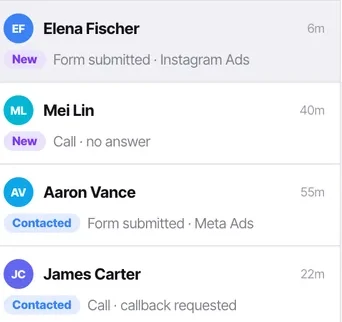
Each row shows the lead stage and the last thing that happened — "Call · no answer", "Call · callback requested", "Form submitted · Instagram Ads". That is usually enough to decide how to open.
Log every outcome, including the boring ones
"No answer" is what keeps the contact in tomorrow's list and out of today's. Skipping it silently is how somebody gets called four times in an afternoon.
Use Today to see who you already handled
It holds whoever you worked on today, which is both a record and the mechanism that stops double-calling.
Check it worked
Work the list until it is empty. Because it is derived, an empty list means there is nobody left to call today — not that you have run out of patience.
The parts people get wrong
- Queue state is derived and read-only. It is never offered for hand entry, because it is a consequence of stage and activity rather than an input.
- An agent sees only their own list. Managers and admins get an assignee filter to look across the team.
- A contact with no owner is in nobody's calling list. If leads are arriving and nobody is calling them, check assignment before anything else.
The ones people actually ask
Why is somebody missing from my list?
Three clauses decide it: assigned to you, in an open lead stage, and not yet called today. A contact in any of the six terminal stages leaves automatically, and logging any outcome removes them until tomorrow. An unowned contact is in nobody's list at all, which is the most common reason a new lead is never called.
Can I reorder the list or set a priority?
No, and there is nothing to configure. The next person is the next person. Anything more complex — everyone in Mumbai untouched for thirty days — belongs in Contacts with the advanced filter builder, saved as a view or turned into a campaign audience.
Why should I log outcomes I do not care about?
Because no answer is what keeps the contact in tomorrow's list and out of today's. Skipping it silently is how somebody gets called four times in an afternoon, and the customer will certainly have noticed.