Write handover conditions
The bot's job includes knowing when it is done. Most disappointing deployments fail at the seam, not at the answer.
People judge an AI deployment on its worst moment, not its average one — and the worst moment is almost never a wrong answer. It is a customer who needed a person and could not get one.
Handover conditions are named situations that end the bot's turn, and each one states where the conversation goes. Writing them well is at least as important as writing the instruction, and it takes about twenty minutes.
Before you start
- A bot to add them to.
- A week of real transcripts, if you have them. They are where the missing conditions come from.
- Somewhere for handovers to land, with a person who is actually watching it.
Steps
Find the handover card on the bot
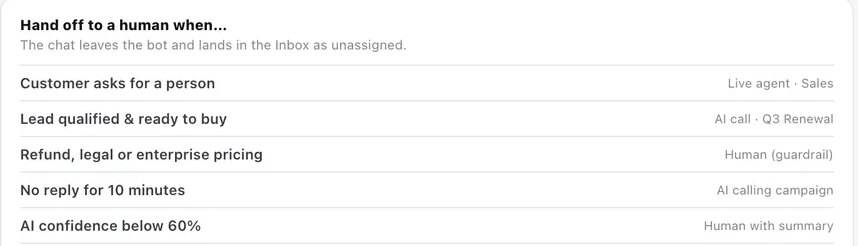
It lists the conditions and, against each, where that conversation goes — a live agent on a named team, an AI call on a named campaign, a guardrail, or a human with a summary.
The card also states what a handover does: the conversation is assigned to an agent, the AI badge disappears and the bot stops. That is the whole mechanism.
Start with the customer asking
"Customer asks for a person" is non-negotiable and should be your first condition. If you write only one, write this one.
Add the commercially valuable ones
"Lead qualified and ready to buy" is a handover you actively want — and note that it can go to an AI calling campaign rather than to a person, which is often faster.
Add the risky ones
"Refund, legal or enterprise pricing" is a guardrail. These are the conversations where being wrong is expensive, and handing over is much cheaper than being confidently wrong.
Add the failure-detection ones
"No reply for 10 minutes" and "AI confidence below 60%" catch the situations you did not predict. They are the safety net under everything else, and most bots that go badly are missing these.
Name a destination for every condition
A live agent on a named team, an AI call on a named campaign, a human with a summary, or a guardrail. A handover with no named destination is a conversation that stops.
Add new conditions with the inline field
The card has a text field and an Add button, so conditions are cheap to add as you learn from real transcripts. Read a week of conversations and add the situations customers got stuck in.

Test each condition by triggering it
One at a time, as a customer would, until each has produced a handover. Until a condition has fired you have only checked that you typed it.
Check it worked
Trigger every condition and confirm two things each time: the bot stops, and a real person or campaign actually receives the conversation with the history intact. The second half is where handovers usually fail.
The parts people get wrong
- A bot with no handover conditions will keep trying forever. That is the worst failure mode available and it is entirely preventable.
- Handing over assigns the conversation to an agent. The AI badge goes, the bot stops, and the thread stays whole — the customer sees one continuous conversation rather than a transfer.
- Make sure somebody is watching wherever it lands. A perfect handover to a person who is not there is still a customer waiting.
- Read your transcripts monthly and add the conditions your customers taught you. This list should grow.
The ones people actually ask
What is the one condition I must have?
Customer asks for a person. If you write only one, write that one, then test it by asking for a person. A bot with no handover conditions will keep trying forever, which is the worst failure mode available.
The bot hands over but the customer still waits.
Nobody is watching where it lands. A handover assigns the chat — if it assigns to somebody who is not there, or into a queue nobody monitors, the handover worked perfectly and the customer is still waiting. Walk your conditions and ask, for each, who receives it and whether they are there.
How do I find the conditions I am missing?
Read a week of transcripts and look for where customers gave up or repeated themselves. That is your list, written by your actual customers rather than guessed. Conditions are cheap to add from the inline field on the handover card.
What does a handover actually do?
The conversation is assigned to an agent, the AI badge disappears and the bot stops — permanently, for that thread. That is the whole mechanism, which is why there is no hand-back-to-bot action.