
What only an admin can do
Money and access. Everything an admin exclusively controls either costs something or lets somebody in.
The admin boundary is drawn around two things: money and access. Everything exclusively admin either binds the company financially or lets somebody — or some system — in.
Knowing the list matters for a practical reason: it tells a manager what to ask for, and it tells you who genuinely needs to be an admin. Most teams need two or three, not six.
Before you start
- Nothing. Read it before you decide who your second admin is.
Reference
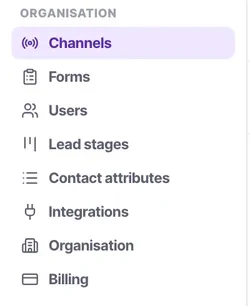
Billing and plan changes
It costs money and binds the company. Plan changes, payment method, usage summary and cancellation all sit here.
Channel credentials and connecting channels
Connecting a line means credentials, a carrier account and a bill. Managers operate channels; admins connect them.
User management and roles
Granting access is the other half of the admin line, and it includes deciding who else becomes an admin.
Keep the number small — two or three for a team of twenty — but never one. A single admin is a single point of failure for billing, credentials and every other admin action.
The contact schema and lead stages
Both define what a contact is for everybody. Changing them changes the product for the whole team, and lead stages in particular drive the calling list.
Export
A full contact export is the single most sensitive thing this product can produce — a spreadsheet of personal data with no access control once it leaves.
Integrations, API keys and forms
Access by another name. An API key is a credential that can read and write everything.
Organisation settings and white labelling
Anything that changes the workspace for everyone who uses it, including branding and the process defaults.
The test for whether something belongs here is simple: if one person changing it silently would confuse everybody else, it is an organisation setting.
Put it to use
Count your admins. If it is more than three or four for a team of twenty, work out who needs to spend money or grant access — and move the rest to manager.
The parts people get wrong
- The product shows admin-only controls to managers rather than hiding them, so a manager can see what to ask for instead of concluding the feature does not exist.
- Keep at least two admins, and make sure they are not both likely to be on holiday at the same time.
The ones people actually ask
Can managers see billing information?
No, billing, invoices, and plan changes are completely locked to admins for security and financial control.
What happens if our only admin leaves?
You lose control of billing and credentials. This is exactly why you must always have at least two active admins.
Can a manager generate an API key?
No, API keys grant complete access to read and write everything. Only an admin can generate or revoke them.
Why are lead stages controlled only by admins?
Because lead stages define the structure of your contact data. Changing them affects everyones calling list and workflow.
Can I restrict an admin to only billing?
No, the admin role is all-encompassing. An admin has access to billing, credentials, user management, and exports.
How many admins should we have?
Two or three for a team of twenty. Never one — a single admin is a single point of failure for billing and every credential in the workspace, and it becomes a real problem the week a card expires while they are on holiday.
Why is export admin-only?
Because a full contact export is the single most sensitive thing this product can produce: a spreadsheet of personal data with no access control once it leaves the building.
How do I decide whether something should be an admin action?
Ask whether one person changing it silently would confuse everybody else, or whether it costs money or grants entry. Either answer means admin.