
Add steps that run in order
Numbered steps, top to bottom. The order is the logic — and a delay can live inside a step rather than needing its own block.
Steps run top to bottom, numbered. There is no branching, no parallel path and no loop — which sounds limiting until you notice that almost every automation people actually want is a short ordered list.
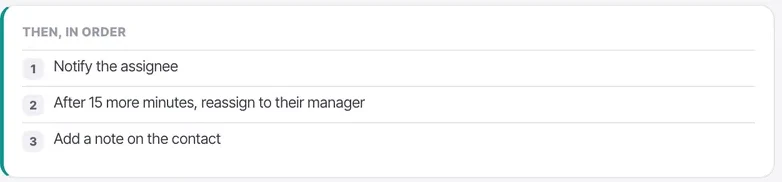
One thing worth seeing early: a delay lives inside a step. "After 15 more minutes, reassign to their manager" is one step, not a wait block followed by an action. That keeps the escalation pattern — do something, wait, escalate — readable as three lines.
Before you start
- A workflow with its trigger and any condition settled.
- The multiplication done: steps times how often the trigger fires.
Steps
Add steps under "Then, in order"
Numbered and sequential. The order is the whole logic — there is no branching, no parallel path and no loop.
That sounds limiting until you notice that almost every automation people want is a short ordered list, and that the ones which are not are usually two workflows pretending to be one.
Put the customer-facing step first
If the workflow sends an acknowledgement, send it before the internal bookkeeping. The customer is waiting; the note on the contact is not.
Then the internal steps
Notify somebody, reassign, create a task, move the stage, add a note.
Use an in-step delay for escalation
"After 15 more minutes, reassign to their manager" is the classic second step. Notify the person, give them a fair chance, then escalate — all readable in two lines.
End with a record step
"Add a note on the contact" is a good last step. It means the next human to open that record can see the automation ran and what it did, rather than being puzzled by a reassignment nobody made.
Keep it under about five steps
Longer than that and nobody can predict what it does. Two workflows are almost always clearer than one long one.
Count the cost before you enable it
Steps × how often the trigger fires. A five-step workflow on a trigger firing 500 times a week is 2,500 automation actions weekly.
Check it worked
Read the steps aloud in order. If the sequence makes sense as spoken instructions to a colleague, it will behave the way you expect. If you have to explain the order, reorder it.
The parts people get wrong
- Automation actions are counted per step, not per run. This is the arithmetic people get wrong.
- For a long wait — hours or days — use a time-hold rather than a chain of in-step delays.
The ones people actually ask
Can steps branch or run in parallel?
No. Steps run top to bottom, and that is the whole logic — no branching, no parallel path, no loop. Almost every automation people want is a short ordered list, and the ones that are not are usually two workflows pretending to be one.
What order should workflow steps go in?
Customer-facing first. If the workflow sends an acknowledgement, send it before the internal bookkeeping — the customer is waiting and the note on the contact is not. End with a record step so the next human can see the automation ran.
How many steps is too many?
About five. Longer than that and nobody can predict what it does, and two workflows are almost always clearer than one long one. Count the cost too: steps multiplied by trigger frequency is your monthly action consumption.