
Build a campaign audience
A dynamic filter, a static list, or an import. The choice between them matters far more than people expect.
Three ways to define who a campaign calls, and they behave very differently once it is running.
A dynamic filter keeps evaluating: new contacts matching the rule join the campaign as they appear. A static list is fixed at the moment you build it. An import brings people in from outside.
The choice has a consequence people discover late: a dynamic filter can grow while you are not watching. That is the feature — an ongoing "new leads" campaign should pick up new leads — and it is the risk, if the rule is broader than you thought.
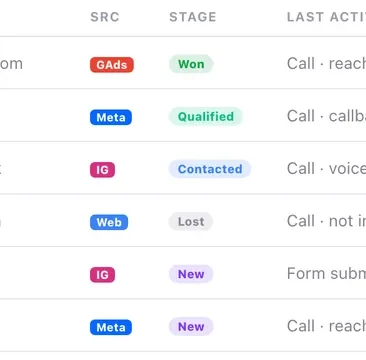
Before you start
- A clear sentence describing who should be called and why.
- Contacts whose phone numbers carry country codes.
- A decision on dynamic versus static before you build it.
Steps
Choose a dynamic filter when the audience should keep changing
Built with the same advanced filter builder as Contacts. Right for anything ongoing.
Choose a static list when it must not change
An event follow-up, an announcement, anything you need to describe exactly afterwards. "We called these 340 people" is a sentence you can only say about a static list.
Choose an import for a one-off external list
From an event, a partner, or a purchased source. Import it, then look at it before you dial — imported lists are where phone-number formatting problems live.
Exclude terminal stages explicitly
DND, Not interested and Wrong number should never be in a calling audience. Filtering on open stages does this for you, which is the strongest argument for building audiences that way.
Check the count before you start
An audience an order of magnitude larger than you expected is a filter mistake, and it is vastly cheaper to find now than after four thousand dials.
Open three contacts from the audience
Counts lie; records do not. Confirm each of the three belongs in this campaign.
Confirm you are permitted to call them
Especially for imported and purchased lists. An autodialler will happily break rules you have not read, at volume, in a way that is documented on every contact's timeline.
Check it worked
After the first fifty dials, look at the outcome distribution. A high rate of "wrong number" tells you about your data source; a high rate of "not interested" tells you about your targeting. Both are audience problems rather than script problems.
The parts people get wrong
- A dynamic filter can grow while the campaign runs. Check the rule rather than the current count.
- Every attempt lands on each contact's activity feed, so you can always reconstruct who was called and why.
- Because terminal outcomes move the lead stage, a campaign built on open stages self-cleans as it runs.
The ones people actually ask
Should I use a dynamic filter or a static list?
Dynamic when the audience should keep changing — anything ongoing. Static when it must not: an event follow-up, an announcement, anything you need to describe exactly afterwards. We called these 340 people is a sentence you can only say about a static list.
The audience is far bigger than I expected.
A filter mistake, and vastly cheaper to find now than after four thousand dials. Check the count, then open three of the matched contacts — counts lie and records do not. A filter returning a plausible number and the wrong people is the most expensive kind.
How do I stop calling people who have said no?
Filter on open stages, which excludes DND, Not interested and Wrong number automatically. That is the strongest argument for building audiences that way rather than listing exclusions by hand.